Agent harness examples: the parts, shown on one ad question
An agent harness is the software around a language model that runs its loop, executes its tools, holds its context and applies its permissions. LangChain writes it as Agent = Model + Harness, and Anthropic calls its Claude Agent SDK a general-purpose agent harness. The examples below follow one question, why conversions dropped last week, through each part and show what is missing when a part is absent.
What counts as an agent harness
The vendors word it differently. Microsoft's Learn page calls a harness "the runtime scaffolding that turns a language model into an agent that can perform work". Google Cloud describes "a software environment that surrounds an artificial intelligence model", with tools, memory of past interactions and multi-step tasks. LangChain says a raw model is not an agent until a harness gives it state, tool execution, feedback loops and enforceable constraints.
Named examples, as of November 2026, and what each one's own documentation lists:
| Harness | Publisher | What the documentation lists |
|---|---|---|
| Claude Agent SDK | Anthropic | Built-in tools, hooks, subagents, MCP, permissions, sessions |
| Claude Managed Agents | Anthropic | A hosted harness, labeled beta, that runs the agent loop, with sessions in a cloud sandbox that Anthropic manages or one you host |
| Agent Framework Harness | Microsoft | An iteration limit on tool calls, todo tracking, plan and execute modes, file memory, tool approval, OpenTelemetry, optional background agents and shell tools, in .NET, Python and Go |
| Codex, in OpenAI's harness engineering post | OpenAI | A repository with an AGENTS.md file, documentation and feedback loops that a team built around Codex agents |
Sources draw the line between a harness and a framework in different places. Google Cloud says an orchestration framework focuses on the developer experience of writing the code and a harness on the runtime environment. Microsoft ships its harness inside Agent Framework.
The question with a chat model and with a harness
A chat model with no tools answers from what the person pastes in. Google Cloud writes that "Language models can't browse the web, query databases, or send emails on their own." Asked why conversions dropped last week, it can list usual causes, such as broken tracking, a budget cut or a promotion that ended, but it cannot check them. The person runs each query and pastes the result back.
A harness closes that gap with a loop. The Agent SDK documentation describes the cycle. The model receives the prompt with the system prompt, tool definitions and history. It replies with text, tool call requests or both. The SDK runs the requested tools and feeds the results back, and the cycle repeats until the model answers with no tool calls. Anthropic's guide to building agents says agents are typically just language models using tools based on environmental feedback in a loop, and that stopping conditions such as a maximum number of iterations keep control. The SDK offers max_turns and max_budget_usd for that, and says that without limits the loop runs until the model finishes by itself.
Tools that query the ad account
The first tool call in our example is a query. Google Ads reports come from GAQL, and a harness exposes it as a tool the model fills in.
SELECT segments.date, campaign.name, metrics.clicks,
       metrics.cost_micros, metrics.conversions
FROM campaign
WHERE segments.date DURING LAST_14_DAYS
ORDER BY segments.date
Google's date range documentation defines LAST_14_DAYS as the last 14 days not including today, evaluated in the account's time zone, so on 26 November it covers 12 to 25 November. The metrics reference says metrics.conversions counts only conversion actions whose include_in_conversions_metric attribute is true. So a changed conversion setting can move this number without a single click changing.
There is also a timing trap. A 2019 announcement in the Google Ads Help Center says standard columns attribute a conversion to the date of the click, and the metrics reference lists metrics.conversions_by_conversion_date for the date it happened. The newest days can therefore still gain conversions after the agent has read them, so part of a drop may fill in later.
The second query asks what changed in the account.
SELECT change_event.change_date_time, change_event.user_email,
       change_event.change_resource_type, change_event.changed_fields,
       campaign.name
FROM change_event
WHERE change_event.change_date_time >= '2026-11-12'
  AND change_event.change_date_time <= '2026-11-27'
ORDER BY change_event.change_date_time DESC
LIMIT 200
The change event guide requires a date filter within the past 30 days and a LIMIT of at most 10,000 rows, and its samples set the upper bound to tomorrow. It warns that change events may omit some changes that the web client's Change History shows. The field reference lists campaign among the resources selectable with change_event, so campaign.name is valid here. A harness passes on what a tool returns, gaps included.
The sandbox that runs code on the data
Two weeks of daily rows per campaign is a lot to total in prose. LangChain gives the model a general-purpose tool such as bash, so that it solves problems by writing and executing code, and lists a sandbox among the infrastructure a harness bundles.
import pandas as pd

df = pd.DataFrame(rows)  # rows returned by the first query
df["period"] = (pd.to_datetime(df["date"]) >= "2026-11-19").map(
    {True: "last 7 days", False: "prior 7 days"}
)
by_campaign = (
    df.groupby(["campaign", "period"])[["clicks", "cost_micros", "conversions"]]
    .sum()
    .unstack("period")
)
by_campaign["conv_change"] = (
    by_campaign[("conversions", "last 7 days")]
    - by_campaign[("conversions", "prior 7 days")]
)
print(by_campaign.sort_values("conv_change").head(10))
The output shows which campaigns lost conversions and whether their clicks and cost fell with them. Clicks that held steady while conversions fell suggest tracking or the landing page. Clicks that fell suggest budgets, bids or ad approvals, which is where the change event query helps.
Context and memory before the question
Which campaigns are brand search, which conversion actions count, and that a sale ended on the 14th are facts the account does not return in a query. A harness supplies them through memory files. LangChain describes memory file standards such as AGENTS.md that are injected into context at the start of a session and that the agent can edit, so knowledge from one session reaches the next.
OpenAI's team tried one big AGENTS.md file, wrote that it failed because "Context is a scarce resource", and replaced it with a file of roughly 100 lines that points to a docs directory. Anthropic's context engineering post recommends the smallest possible set of high-signal tokens, describes context rot as recall falling as the window fills, and favors keeping lightweight identifiers such as stored queries that are loaded through tools when needed.
For work that outlasts one window, Anthropic's long-running agents post uses a progress file and git history so a fresh session can see what happened. Its later harness design post says models lose coherence as the window fills and that compaction leaves context anxiety in place. Context resets solve both, at the cost of orchestration complexity, token overhead and latency on each run.
Delegation to other agents
The conversion question spans Google Ads, Meta and Google Analytics. The Agent SDK's subagent documentation says a subagent runs in its own conversation, its intermediate tool calls stay inside it, and only its final message returns to the parent. Subagents can run in parallel, and Anthropic's context engineering post says a returned summary is often 1,000 to 2,000 tokens.
Anthropic's agents guide adds that autonomy means higher costs and the potential for compounding errors, and recommends extensive testing in sandboxed environments with guardrails.
Permissions and approval
Suppose the agent concludes that one campaign should be paused. Reading the account and changing it are different acts, and the harness decides which needs a person. The SDK's permissions page lists the order a tool call passes through, starting with hooks, then deny rules, then ask rules, and says a deny rule holds even in bypassPermissions mode. Microsoft's harness lists tool approval with standing approvals and auto-approval rules enabled by default.
The parts, on this question:
| Part | Job in the conversion question | Without it |
|---|---|---|
| Loop | Runs query, reads result, queries again | The person relays each result by hand |
| Tools | GAQL on performance and on change events | The model lists causes it cannot check |
| Sandbox | Totals two weeks of rows by campaign | The arithmetic happens in prose |
| Context and memory | Brand campaigns, counted conversion actions, last promotion | The agent flags a planned drop as a problem |
| Delegation | One subagent per data source, summaries returned | One window fills with raw rows |
| Permissions | Reads run freely, a pause needs a person | One wrong call changes live spend |
Alpue Studio as a harness
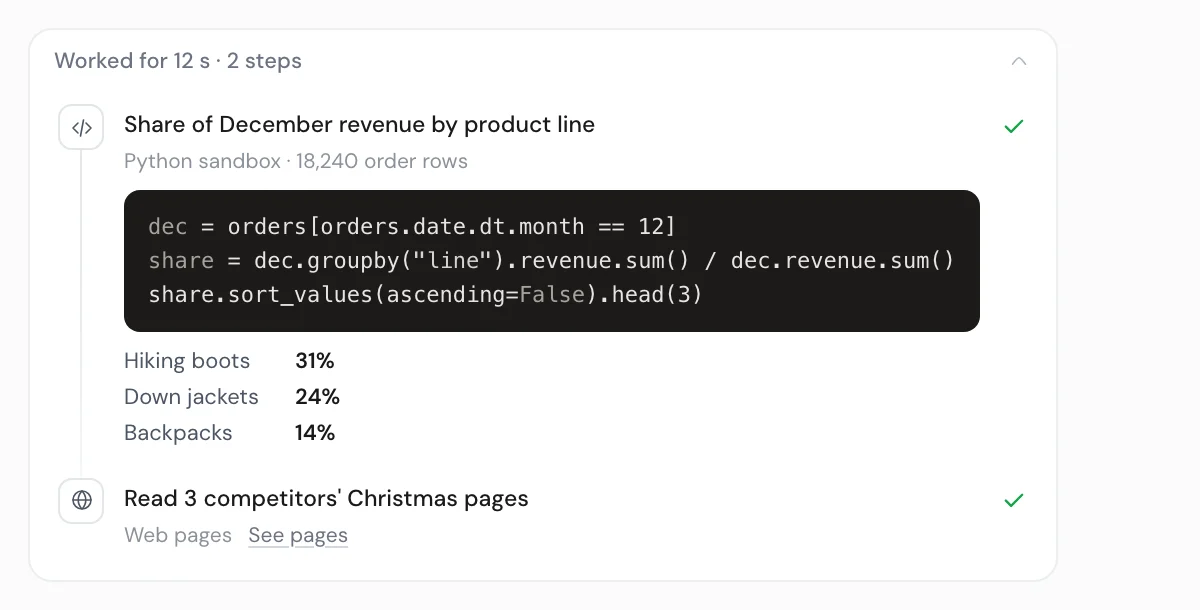
Alpue Studio is a harness built for marketing. The agent writes its own GAQL against Google Ads and queries Meta, Sklik, Google Analytics 4, Search Console and Merchant Center, and each query opens under "See query". When a question needs more than a query, it writes Python and runs it in a cloud sandbox, and the code is shown with the result. It keeps notes between conversations and hands tasks to departments such as Performance and Analytics. The agents page has more.
The agent has no tool that pushes changes to an ad account. A campaign reaches Google Ads, Meta or Sklik only when a person with the right role drags a slider, and the security page covers keys and workspaces. Its custom connections are read-only, it has no autopilot mode, and there is no self sign-up, so teams ask for access on the access page. The difference between a harness and a single agent is in AI agent vs harness, and the difference from an MCP server is in MCP server vs agent harness.
Questions
What is an agent harness?
It is the code and configuration around a model that is not the model itself. LangChain lists the system prompt, tools, a sandbox, orchestration and hooks, and Microsoft lists approval policies and conversation state.
Is a harness the same as an agent framework?
The sources disagree. Google Cloud treats a framework as the developer's code and a harness as the runtime, while Microsoft's harness is part of its Agent Framework.
What are examples of agent harnesses?
The Claude Agent SDK and Claude Managed Agents from Anthropic, the Harness in Microsoft's Agent Framework, and the Codex setup OpenAI describes in its harness engineering post.
Does the harness matter more than the model?
The documentation does not measure that. Anthropic says harness design has a substantial impact on the effectiveness of long-running agentic coding, and OpenAI wrote that early progress was slow because the environment was underspecified. Both describe software work, none of the sources above tests ad accounts, and neither company measures a harness change against a model upgrade, though Anthropic's later post says Opus 4.5 let it drop context resets from one harness.
Sources
- The Anatomy of an Agent Harness, LangChain. Read 26 November 2026.
- Effective harnesses for long-running agents, Anthropic. Read 26 November 2026.
- Harness design for long-running application development, Anthropic. Read 26 November 2026.
- Building effective agents, Anthropic. Read 26 November 2026.
- Effective context engineering for AI agents, Anthropic. Read 26 November 2026.
- Agent SDK overview, Claude Code Docs. Read 26 November 2026.
- How the agent loop works, Claude Code Docs. Read 26 November 2026.
- Subagents in the SDK, Claude Code Docs. Read 26 November 2026.
- Configure permissions, Claude Code Docs. Read 26 November 2026.
- Agent Harness, Microsoft Learn. Read 26 November 2026.
- What is an agent harness?, Google Cloud. Read 26 November 2026.
- Harness engineering: leveraging Codex in an agent-first world, OpenAI. Read 26 November 2026.
- Date ranges, Google Ads API documentation. Read 26 November 2026.
- Metrics reference, v26, Google Ads API documentation. Read 26 November 2026.
- Change event, Google Ads API documentation. Read 26 November 2026.
- ChangeEvent fields, v26, Google Ads API documentation. Read 26 November 2026.
- Claude Managed Agents overview, Claude Platform Docs. Read 26 November 2026.
- Understand conversions by time with new columns, Google Ads Help. Read 26 November 2026.